
LOCAL News :: Peace & War
UC Manages Armageddon


A
History of the Labs
The
model example of military university collaborative research is the inception,
design, and creation of the atomic bomb. Conceived and developed by University
of California, the creation of the most deadly device ever made was a product
of research funded by the military and conducted by an elite group of Americas
university scientists, professors and graduate students.
Since
the Los Alamos Laboratory opened its doors in 1943, every single nuclear weapon
built for the United States arsenal was designed at a University of California
managed weapons laboratory. The history of the development of Los Alamos and
the second National Laboratory, Lawrence Livermore laid the foundation for the
last fifty years of military research and development conducted on Americas
college campuses.
In |  |
Upon
discovery that the production of a nuclear bomb was possible, the scientists
still had questions they need answered, instruments necessary for production,
and a full-time staff consisting of Americas most advanced scientists, many
of whom were prestigious faculty of some of the nations public research institutions.
The LANLs website details the need for a laboratory dedicated to nuclear research:
By September 1942, the difficulties involved with conducting preliminary studies
on nuclear weapons at universities scattered throughout the country indicated
the need for a laboratory dedicated solely to that purpose.(1)
Theoretical studies were well underway up until this point, but a laboratory
dedicated to production, research, design, and testing was soon underway, under
command of General Leslie Groves, who was deputy to the chief of construction
for the Army Corps of Engineers during construction of the Pentagon.
n 1943 construction on the Los Alamos National Laboratory was completed. Los
Alamos in New Mexico was chosen by Oppenheimer and Groves because of its isolated
location (it had to be at least 200 miles from any ocean or national boundary),
mild climate, and because Canyons surrounding the site could be used for explosives
tests.1 The Office of Scientific Research and Development provided funding,
and the small town of Los Alamos was forcefully evacuated under military command
in February 1943. Among the crew of 450 scientists and technicians to immediately
move into Los Alamos were Ernest Lawrence, founder of both the UC Berkeley and
MIT Radiation Laboratories, and whom the Lawrence Livermore Laboratory would
later be named, as well as scientists from Stanford, Purdue, Columbia, University
of Illinois, and University of Rochester. The scientists saw their new lab not
as a military institution, but, instead, it was to become an outpost of academia.(1)
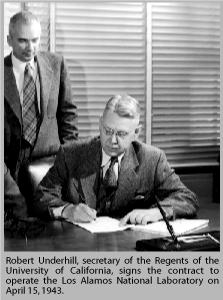
The
University of California Signs a Contract
 | The |
Interestingly,
the UC Regents upon signing the contract were unaware of the project to build
a nuclear bomb at the Los Alamos site. Not until after the war, after the bombs
had been used to kill and maim millions of Japanese civilians, did the University
really become aware of what it was managing. Following the war, a weak attempt
was made to sever ties with the labs, but it was never accomplished. Today,
the University of California takes a proud stance on its management of the labs,
calling it a public service to the nation.(2)
The
Atomic Energy Commission, created in 1947, was formed to oversee nuclear weapons
research, development, production, and testing; production of plutonium and
weapons grade uranium; milling and refining of uranium ore; biomedical research
into the effects of radiation and nuclear weapons; basic nuclear research in
fields such as chemistry, physics, and metallurgy; development of nuclear reactors;
and promotion of a civilian nuclear power industry.3 Since its inception, which
was a direct result of the creation of the national nuclear laboratories, the
AEC has been responsible for funding and oversight of the management of the
labs by the UC. In 1975, the AEC became a part of the Department of Energy,
with whom the UC is now contracted in the management of both LANL and LLNL.
In
1952 UC founded the second national weapons laboratory, Lawrence Livermore located
in the East Bay, transferring many research scientists from the UC Berkeley
Radiation Laboratory for increased work on nuclear weapons. It was believed
that the creation of a second laboratory would instigate a rivalry between scientists
at both labs, creating an atmosphere of competition that would spur technological
discoveries, and would fuel a US advantage in the arms race.
LANL
and LLNL Today
Today,
the three laboratories (including Lawrence Berkeley Laboratory) have a combined
UC workforce of 18,000 and operate on federally financed budgets totaling nearly
$4 billion.2 Along with nuclear weapons research, LANL and LLNL conduct civilian
studies as well, such as energy, space, and medical research. The vast amount
of funding, however, given by the Department of Energy to the UC for managment
of the labs is used for weapons research. In 2002, LANL recieved 1.2 billion
dollars for research and development of nuclear weapons, which was 80% of its
entire DOE funding for that year.(5)
The
budget for 2004 from the DOE for total weapons activities will be 6.4 billion
dollars, an increase of 9% from 2003. 7 This is 30% of the entire annual DOE
budget of $21 billion. The $6.4 billion is distributed by the semiautonomous
National Nuclear Security Administration, primarily to the three national nuclear
labs in the United States: LANL, LLNL, and Sandia National Laboratory in New
Mexico which is managed by the Lockheed Martin Corporation. The Los Alamos Laboratory
will recieve 1.3 billion dollars for weapons research, Lawrence Livermore will
receive 1.2 billion. (6) That means that this
year, of the $4 billion dollar combined budget the University of California
manages for the labs, $2.5 billion, or 63% will be used for nuclear weapons
research.
The $2.5 billion is spent on various nuclear weapons programs, including the
Stockpile Stewardship Program, which provides for upgrades of every nuclear
weapon the US has, and the development of new nuclear weapons, under the guise
of stabilizing an already existing arsenal of weaponry. The goal of the SSP
is to enhance the capabilities of the US nuclear weapons stockpile. In that
pursuit, NNSA is modifying, altering, refurbishing, performing life extensions
on, and replacing life components in all of the weapons in the stockpile.6
Though a huge portion of the DOEs budget is devoted to these weapons improvement
programs, the budget contains very little information about them.
Also
being researched by University of California employees is the Robust Nuclear
Earth Penetrator, with a $45 million budget over three years for design and
theoretical framework. Construction of the RNEP is set to begin in the spring
or summer of 2003 at LANL, and it will be the first new nuclear weapon to be
added to the US arsenal since 1989. It has been touted as a more useable nuclear
weapon, its objective to burrow hundreds of feet below the ground before detonation
in a bunker-busting technique. Not only does preliminary research prove the
RNEP ineffective, but it shows that if used in an urban setting, the radiation
emitted, though underground, would be enough to kill 50,000 people in the first
24 hours. Bush Administration rhetoric has been heavily saturated with threats
of first-strike nuclear use, and the development of a new nuclear weapon designed
for battlefield use has disastrous consequences in the international arms control
regime.
The
University of California is responsible for environmental destruction through
the development of these weapons. 47,500 barrels of toxic waste from the UC
Lawrence Livermore Lab has been dumped off the coast of San Franciscos Farrellon
Islands, the largest fishery on the west coast. The University also cheats local
schools out of much needed tax revenue. Both LANL and LLNL pay no state taxes.
In New Mexico, LANL would pay an estimated 60 million dollars in state tax,
half of which would go to the educational system, however their work is considered
nonprofit and educational by virtue of the fact that it is managed by the
University of California.(7)
The
research of weapons of mass destruction including the RNEP, the management of
the Stockpile Stewardship Program, and the disposal of nuclear waste, are all
fundamental responsibilities of the University of California as lab managers.
Under the guise of fundamental scientific research, backed by one of the nations
most respected institutes of higher learning, laboratory scientists and bureaucrats
are able to continue their legacy of building weapons of mass destruction by
abusing the reputation of this university, its faculty, and its students.
UCSC
and the Labs
Research UCSC | In 1984, three professors from UCSC decided to Later |
The
Modeling and Imaging Laboratory (MILAB) in the Geophysics department at UCSC
is also funded by Los Alamos National Laboratory, as well as the Office of Naval
Research, Air Force Office of Scientific Research, and many petroleum corporations
including BHP, Shell, Chevron, Conoco, and Unocal. MILAB develops theory and
methods for the modeling and imaging of complex environments, assisting American
corporations in the extraction of valuable natural resources available in parts
of the world outside of the United States. The UCSC MILAB website states their
intent clearly:
The Earth is recognized to have hierarchical, multi-scale heterogeneities,
especially in economically, environmentally and/or scientifically interesting
areas. As new oil and gas reserves become more difficult to find and expensive
to drill for, there is increased interest in pinpointing their potential beneath
increasingly complicated structures.(4)
What
other interest would the US military, the weapons laboratory, and these oil
conglomerates have in the geography of these environments if they werent planning
on invading them?
The
Future of the UC Contract
Because
the University of California played such an integral role in the formation of
the partnership between Americas institutes of higher learning and the military,
it is now the responsibility of the UC to disarm our society by disarming our
universities. The creation of the nuclear weapons laboratories, and the continued
management of these factories of destruction by the University of California
sets a precedent to other institutions, faculty, and most importantly the impressionable
student body that military science is not only important, but somehow ethical
and necessary.
Editor's
note: By the time this publication goes to print, the UC may have lost the contract
to manage the Los Alamos weapons lab. This does not invalidate the struggle
to abolish nuclear weapons. In fact the possible transfer of the labs to another
university or private corporation represents the further strengthening of the
nuclear weapons complex and the destruction that they produce. The need to rid
the world of the nuclear threat has never been so urgent.
New Comments are disabled, please visit Indybay.org/SantaCruz
Calendar
Search
Topics
- Alternative Media
- Animal Rights
- Arts & Culture
- Civil & Human Rights
- Education & Youth
- Environment & Food
- Gender & Sexuality
- Globalization & Capitalism
- Government & Elections
- Health & Drugs
- Labor & Economics
- Media Criticism
- Peace & War
- Police State
- Poverty & Urban Development
- Resistance & Tactics
- Sister Cities
- Technology
- Transportation
- Womyn
Information



Views
Media Centers

- worcester
- western mass
- vermont
- urbana-champaign
- tennessee
- tampa bay
- seattle
- sarasota
- santa cruz, ca
- santa barbara
- san francisco bay area
- san francisco
- san diego
- saint louis
- rogue valley
- rochester
- richmond
- portland
- pittsburgh
- philadelphia
- oklahoma
- nyc
- north texas
- north carolina
- new orleans
- new mexico
- new jersey
- new hampshire
- minneapolis/st. paul
- milwaukee
- michigan
- miami
- maine
- madison
- la
- kansas city
- hudson mohawk
- houston
- hawaii
- dc
- columbus
- colorado
- cleveland
- chicago
- charlottesville
- buffalo
- boston
- binghamton
- big muddy
- baltimore
- austin indymedia
- austin
- atlanta
- asheville
- arkansas
- arizona
- valencia
- united kingdom
- ukraine
- toulouse
- toscana
- torun
- switzerland
- sverige
- scotland
- sardegna
- russia
- romania
- roma
- portugal
- poland
- piemonte
- patras
- paris/Île-de-france
- oost-vlaanderen
- nottingham
- norway
- northern england
- nice
- netherlands
- napoli
- nantes
- marseille
- malta
- madrid
- london
- lombardia
- linksunten
- lille
- liguria
- liege
- la plana
- italy
- istanbul
- ireland
- hungary
- grenoble
- germany
- galiza
- euskal herria
- estrecho / madiaq
- emilia-romagna
- cyprus
- croatia
- calabria
- bulgaria
- brussels
- bristol
- belgrade
- belgium
- belarus
- barcelona
- austria
- athens
- armenia
- antwerpen
- andorra
- alacant
- abruzzo
Account Login
This site made manifest by dadaIMC software